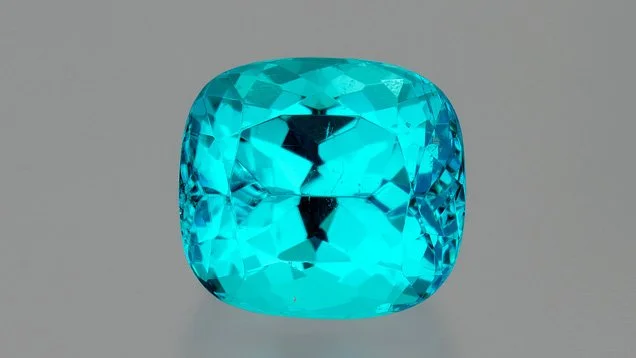
Paraíba Tourmaline: The Gem That Glows from Within
Paraíba Tourmaline: The Neon Treasure of the Gem World
The gem world has gone a little crazy over Paraíba tourmaline because it combines three things that almost never occur together in a coloured gemstone: extraordinary colour, genuine rarity, and remarkable collector demand.
A Colour That Looks Almost Impossible
Most gemstones are beautiful because they reflect light. Paraíba tourmaline appears to generate it.
Its electric blue, turquoise, and neon green colours possess an intensity that can seem almost artificial. Unlike sapphire, aquamarine, or blue zircon, Paraíba exhibits a vivid, almost glowing appearance that remains striking even in low light.
This extraordinary colour is caused by trace amounts of copper within the crystal structure, often accompanied by manganese. These elements interact with light in a way that produces hues unlike those seen in almost any other gemstone. The result is a colour so distinctive that many people seeing a fine Paraíba for the first time respond with the same observation:
"I've never seen a gemstone that colour before."
It Is Genuinely Rare
When the original material was discovered in the Brazilian state of Paraíba during the late 1980s, the deposits were small, difficult to mine, and produced only limited quantities of gem-quality material.
The finest Brazilian stones remain among the rarest coloured gemstones in the world.
Later discoveries in Nigeria and Mozambique increased supply, but exceptional material remains scarce. Fine Paraíba tourmalines above 2–3 carats are uncommon, while stones over 5 carats displaying strong, evenly distributed colour are particularly rare.
What Actually Makes a Paraíba?
Today, the term "Paraíba" refers not only to gems from Brazil but to copper-bearing tourmalines from any locality that display the characteristic vivid blue to green colours associated with the variety.
According to the widely accepted industry definition, Paraíba tourmaline is a blue, bluish-green, greenish-blue, or green tourmaline whose colour is primarily caused by copper and often manganese.
This distinction is important because blue tourmaline can also be coloured by iron. However, iron produces the deeper blue tones seen in indicolite, whereas copper is responsible for the extraordinary neon-like colours that define Paraíba tourmaline.
It Changed the Coloured Gemstone Market
Before Paraíba's discovery, the highest-value coloured gemstones were generally ruby, sapphire, and emerald.
Paraíba created an entirely new category.
Collectors and investors suddenly had access to a gemstone displaying a colour unlike anything previously available. Within a relatively short period, prices rose dramatically, and the finest examples began commanding values previously associated only with the traditional "big three" coloured gemstones.
The Best Stones Are Exceptionally Valuable
In today's market, exceptional Brazilian Paraíba tourmalines can command prices per carat that rival or exceed fine ruby and sapphire.
Collectors typically seek:
Strong neon blue or blue-green colour
High colour saturation
Good clarity
Even colour distribution
Significant size
Brazilian origin, particularly for investment-grade stones
While Brazilian material generally commands the highest prices, there is considerable overlap in colour and quality between stones from Brazil, Mozambique, and Nigeria. Determining geographic origin often requires advanced laboratory testing and chemical analysis.
It Photographs Poorly
Interestingly, Paraíba tourmaline is one of the few gemstones that often looks better in person than it does in photographs.
The copper-induced glow that makes the gem so captivating can be difficult for cameras to capture accurately. Photographs frequently fail to convey the intensity and apparent luminosity visible to the human eye.
Why Collectors Love Them
Paraíba tourmaline belongs to a very exclusive group of gemstones that genuinely changed the industry when they were discovered.
Like tanzanite in the 1960s, it introduced an entirely new colour experience to the gem world.
The combination of extraordinary colour, genuine rarity, limited mining production, strong collector demand, and increasing global recognition has created what many regard as the most important coloured gemstone discovery of the past fifty years.
For someone who appreciates fine gemstones, seeing an exceptional Paraíba tourmaline for the first time is a little like seeing a naturally coloured blue diamond.
The colour simply doesn't look as though nature should be capable of producing it.
Photo by Robert Weldon/GIA; courtesy of David Bindra, B&B Fine Gems